
Physics and Technology
National Research University
Multimodal Deepfake Detection
in Video Conferencing
The visual channel is no longer
proof of identity
Conferencing deepfakes are live, targeted, and interactive. They strike during synchronous calls on Zoom, Teams, and Google Meet, where the counterpart has seconds to judge authenticity and no recourse once deceived.
Wire fraud
Executives impersonated on business calls to authorize fraudulent transfers.
Fake hires
Attackers posing as job candidates through remote interviews and onboarding.
Bypassed KYC
Remote Know-Your-Customer identity checks defeated at financial institutions.
Social attacks
Impersonation of family members targeting elderly relatives.
Conferencing video breaks the
assumptions of existing benchmarks
Standard datasets come from social media and broadcast footage. The conferencing domain differs along four axes at the same time.
Codec compression
H.264 / H.265 at low-latency bitrates, calibrated for transmission rather than visual fidelity.
Constrained pose
Head pose concentrated on the frontal axis. Users are seated, facing a webcam, with limited angular variation.
Low resolution
Source capped by webcam hardware, rarely above 1080p and often well below.
Virtual backgrounds
Segmentation artifacts at the person-background boundary, absent from every standard benchmark.
No prior dataset covers all three
requirements at once
Modern methods
Diffusion transformers and real-time autoregressive avatars from 2024-2026, not pre-2020 GAN swaps.
Conferencing domain
Codec compression, frontal pose, webcam resolution, and virtual-background artifacts together.
Multimodal annotation
Per-clip physiological, geometric, appearance, and semantic cues for interpretable detection.
The closest prior work, Zoom-DF (2022), provided ~1,500 fakes from one first-generation method, and is no longer publicly available. It is inadequate against the 2025-2026 threat landscape.
Three research problems
Dataset construction
Build the first conferencing-domain deepfake dataset with a multimodal annotation framework spanning physiological, geometric, appearance, and semantic cues.
Architecture design
Design and implement a multimodal architecture with joint classification and pixel-level localization, trainable on a single consumer-grade GPU.
Generalization analysis
Quantify the contribution of conferencing-domain data to cross-dataset transfer through controlled ablation studies.
What is mine, and what is the team's
VCDF-X dataset
Joint · teamConstruction pipeline, generation, and the eight-modality annotation framework are a collective contribution. My role: co-investigator on the detection side, and the cross-dataset benchmarking that establishes the dataset's value.
MMGUNet + generalization study
My contributionThe four-modal architecture, the landmark-heatmap modality, the adaptive gating, the dual output head, the training pipeline, and the full cross-dataset ablation experiments are my own design and implementation.
VCDF-X
The dataset
A conferencing benchmark built
on the current threat landscape
| Dataset | Year | Real | Fake | Meth. |
|---|---|---|---|---|
| FaceForensics++ | 2019 | 1,000 | 4,000 | 4 |
| Celeb-DF | 2020 | 590 | 5,639 | 1 |
| DFDC | 2020 | 23K | 100K | 8 |
| ForgeryNet | 2021 | 99K | 121K | 15 |
| Zoom-DF | 2022 | 50 | 1,500 | 1 |
| DF40 | 2024 | – | 100K | 40 |
| VCDF-X (ours) | 2026 | 4,151 | 9,617 | 9 |
Nine modern pipelines, three families
Face swap
Reenactment
Autoregressive streaming: the live real-time threat.
Generative
Text-to-video, no source footage needed.
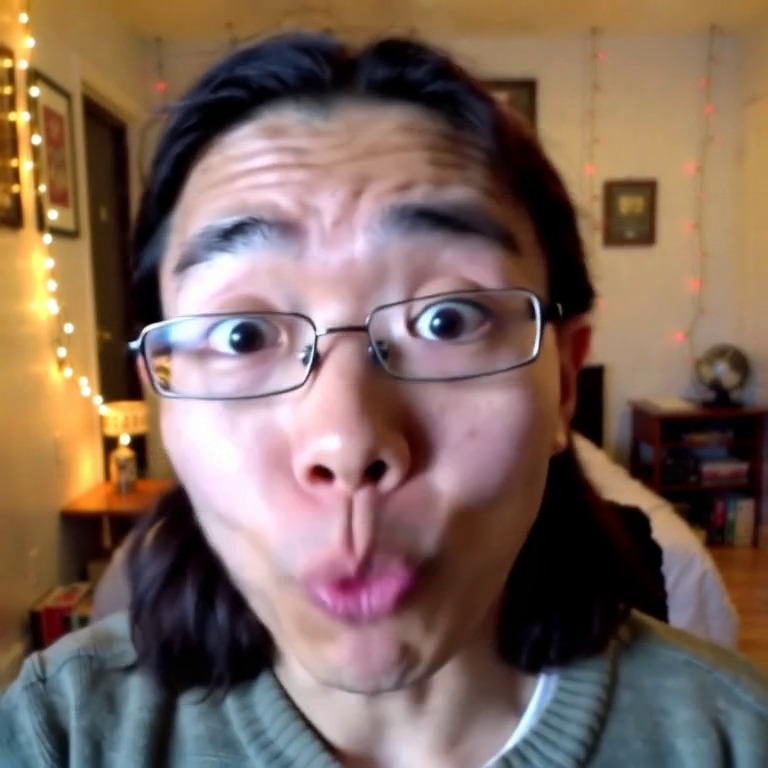 LTX-2
LTX-2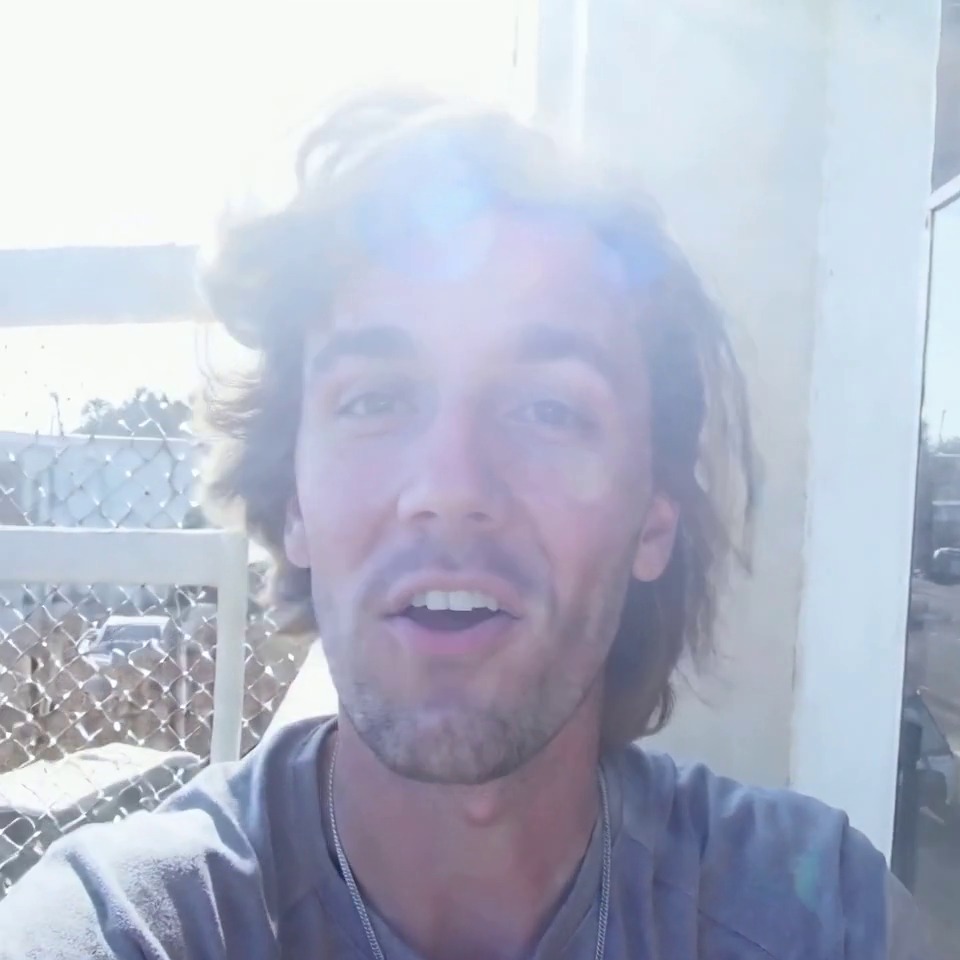 Ovi
Ovi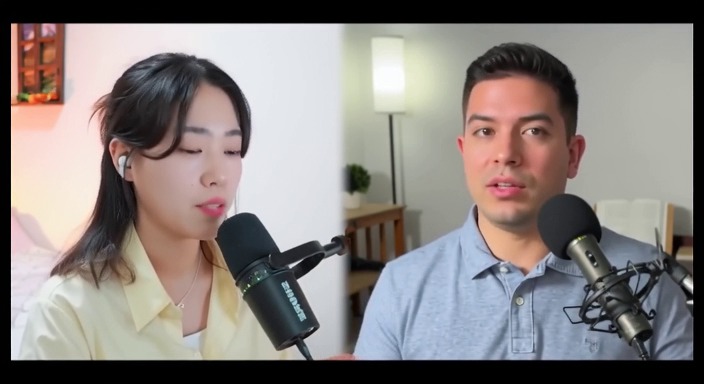 LiveAvatar
Eight modalities on every clip
Computed uniformly on real and fake samples to avoid label leakage. The richest per-sample annotation set in the literature.
Manipulation masks
Face-oval pseudo-masks from MediaPipe FaceMesh.
Facial action units
ME-GraphAU. AU25 lip-part elevated in fakes (0.724 vs 0.648).
Eye gaze
3D gaze vectors. Diagnostic for reenactment.
Depth maps
Depth Anything V2. Catches swaps that break 3D structure.
Face mesh
468-keypoint geometry for temporal consistency.
rPPG signal
PhysNet blood-volume pulse, absent in synthetics.
NL descriptions
Qwen2.5-VL-7B artifact text for explainability.
Demographics
Age, gender, ethnicity, emotion for fairness.
Pseudo-masks from face-oval geometry
- The 36 keypoints of the MediaPipe face oval form a polygon, rasterized into a binary mask per frame.
- For face swaps and reenactments, the mask is a proxy for the manipulated region.
- For fully generative content, the manipulated region is the full frame.
- The same geometry is converted into a Gaussian landmark heatmap, the key input to MMGUNet.
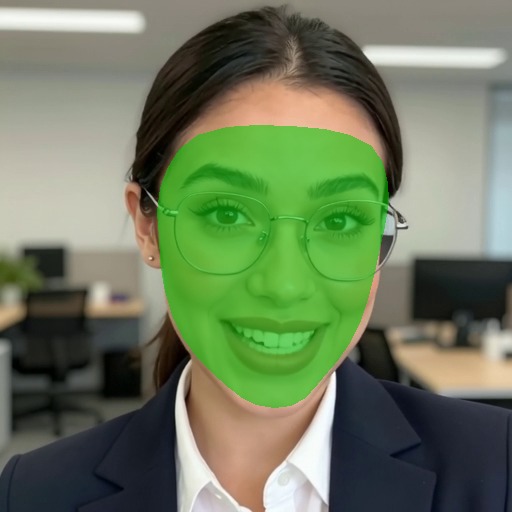 mask overlay
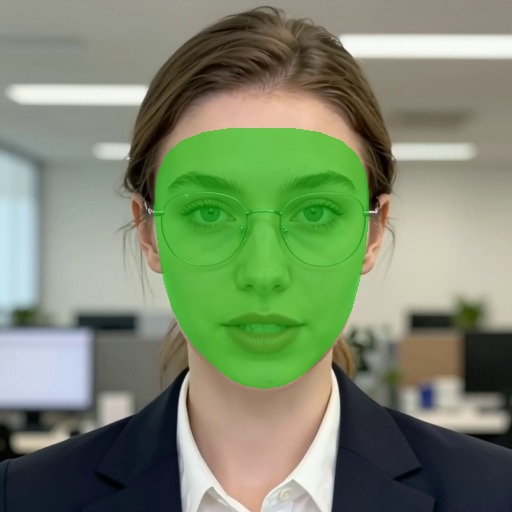 mask overlay
MMGUNet
The architecture
The MMGUNet architecture, end to end
Four complementary views of one frame
Raw RGB
Appearance pattern, ImageNet-normalized for the pretrained encoder.
FFT magnitude
Frequency artifacts of blending and compression; rings at high frequencies.
STFT spectrogram
Over a 1D-flattened frame; preserves where frequency anomalies occur.
Landmark heatmap · NOVEL
Gaussian blobs at 36 face-oval keypoints: an explicit face-region prior.
A gate that amplifies, never zeroes
Standard sigmoid gate
Multiplier in \((0,1)\): the gate can only attenuate, and can drive a modality to zero before its weights stabilize.
Our \((1+\sigma)\) gate
Multiplier in \((1,2)\): the gate amplifies, with a neutral fallback of 1.0. No modality is ever zeroed out.
Dual head, three-term loss
- U-Net decoder reuses ResNet skips \(x_0\dots x_3\) for a \(224\times224\) mask.
- AdamW, lr \(10^{-4}\), warmup + cosine, 15 epochs, batch 32.
Classification
BCE with label smoothing 0.1. Carries the primary training signal.
Weak supervision
On the mean predicted mask. Low-information, so downweighted.
Strong supervision
Pixel-level BCE on approximate pseudo-masks, downweighted to protect accuracy.
Experiments
& results
Three datasets, three domains
FaceForensics++
Broadcast. 127K frames, 4 first/second-gen methods.
Celeb-DF
Social media. 179K frames, high-quality second-gen swap.
VCDF-X
Conferencing. 13,768 clips, 9 third-gen methods.
ImageNet pretraining is the
single largest gain
| Version | Key change | AUC | IoU |
|---|---|---|---|
| v1 | Random initialization | 0.939 | 0.672 |
| v2 | Balanced sampler + method head | 0.913 | 0.643 |
| v3 | LSTM over 8 frames | 0.865 | 0.513 |
| v4 | 1-frame train, 64-frame infer | 0.942 | 0.672 |
| v5 · ResNet18 | ImageNet pretrain | 0.986 | 0.759 |
| v5 · EffNet | EfficientNet-B0 pretrained | 0.979 | 0.756 |
| v6 · ViT-B/16 | Vision Transformer | 0.973 | 0.717 |
| SWIN-T | SWIN + multi-scale masks | 0.946 | 0.175 |
- CNNs beat transformers at this data scale.
- LSTM hurts: 8 frames too short to learn dynamics.
The landmark heatmap drives
the largest single gain
| Modalities | VCDF-X | FF++ | CelebDF | IoU |
|---|---|---|---|---|
| RGB only | 0.962 | 0.917 | 0.984 | 0.701 |
| + FFT | 0.974 | 0.926 | 0.989 | 0.722 |
| + STFT | 0.972 | 0.937 | 0.993 | 0.731 |
| + Landmark (full) | 0.999 | 0.933 | 0.993 | 0.956 |
Standard benchmarks alone score
below chance on conferencing
| Training data | VCDF-X | FF++ | CelebDF |
|---|---|---|---|
| FF++ + CelebDF only | 0.454 | 0.948 | 0.995 |
| VCDF-X only | 0.999 | 0.510 | 0.570 |
| All three combined | 0.999 | 0.933 | 0.993 |
Matches or beats MDF on simpler inputs
| Model | Train | Test | AUC | F1 |
|---|---|---|---|---|
| In-domain (train & test on VCDF-X) | ||||
| ResNet-50 | VCDF-X | VCDF-X | 0.974 | 0.975 |
| Swin-V2-Base | VCDF-X | VCDF-X | 0.997 | 0.975 |
| MDF (FAU + rPPG) | VCDF-X | VCDF-X | 0.980 | 0.907 |
| MMGUNet (3-modal) | VCDF-X | VCDF-X | 0.983 | 0.950 |
| Combined training → per-domain test | ||||
| MDF | All three | FF++ | 0.935 | 0.808 |
| MDF | All three | CelebDF | 0.998 | 0.981 |
| MDF | All three | VCDF-X | 0.975 | 0.907 |
| MMGUNet (4-modal) | All three | FF++ | 0.933 | 0.944 |
| MMGUNet (4-modal) | All three | CelebDF | 0.993 | 0.988 |
| MMGUNet (4-modal) | All three | VCDF-X | 0.999 | 0.993 |
Three findings, three mechanisms
Pretraining dominates
ImageNet features regularize the encoder against dataset-specific noise. Larger gain than any architectural change.
Geometry prior helps most
The landmark heatmap decouples the face signal from background, exactly where conferencing differs.
Combined training is required
No implicit transfer from broadcast GAN content to conferencing diffusion content.
Contributions & what comes next
VCDF-X
JointFirst conferencing-domain benchmark, 8 modalities. Submitted to ACM MM 2026.
MMGUNet
MineAUC 0.999 / 0.933 / 0.993 under combined training. Beats MDF on simpler inputs.
Generalization
MineFirst quantitative measure: single-source fails below chance on conferencing.
Dataset Track · #335
Questions are welcome
Backup
slides
Mean score by source label
| Source label | Mean score | N |
|---|---|---|
| Real | 0.288 | 164 |
| LTX-2 (AIGC) | 0.786 | 157 |
| Ovi (AIGC) | ~ | <30* |
| dlc (Inswapper+GFPGAN) | 0.598 | 44 |
| LiveAvatar (14B) | 0.568 | 92 |
| FaceFusion / VisoMaster / DreamID-V | ~ | <30* |
- Real well-separated from every fake label.
- AIGC easiest: no natural acquisition noise to mimic.
- Hardest: LiveAvatar (no blend boundary) and dlc (GFPGAN smooths the FFT signature).
- * <30 videos: reported for completeness, not statistically interpretable.
Where the detector errs
Unusual lighting → fake
Low-light and backlit scenes: natural shadow boundaries read as blending artifacts.
Short LiveAvatar → real
Clips under 12s lack the temporal signature the model relies on; autoregressive output is incoherent early.
Heavy makeup → fake
Extreme appearance modifications and occlusion were unseen in training and look like artifacts.
Split granularity & in-domain leakage
The caveat
Clip-level random split does not guarantee source disjointness: long recordings were segmented into sibling clips, and swaps share a synthetic identity pool. In-domain AUC ≈ 0.999 is an optimistic upper bound.
Why the finding holds
The generalization claims are cross-dataset. Transfer failures are measured on FF++ and CelebDF, which share no source, identities, or pipelines with VCDF-X. Those numbers are independent of the VCDF-X split.
Stated plainly
- Simulated transmission: offline segmentation and post-hoc compression, not real Zoom/Teams pipelines.
- Demographic imbalance: reflects source YouTube distribution; some subgroups underrepresented.
- STFT semantics: non-standard on a flattened image; a 2D wavelet basis would be more principled.
- No temporal modeling: mean aggregation discards temporal statistics; LSTM hurt.
- Single-GPU scale: results are a single-GPU baseline, not a scale-frontier result.
- Real-time gap: ~60-80 FPS on the training GPU; deployment needs quantization or a smaller backbone.